Bathware Knowledge Base

Latest Bathware Insights & Industry News

Expert guides, design inspirations, and technology innovations for luxury bathroom solutions.

Buying Guides

Smart Toilet Buying & Selection Guides

Understanding auto-flush technology, heating controls, and ceramic durability.

Technical Insights

Thermostatic Shower Engineering

Precision temperature management & wall-mounted brass fixture trends.

Design Trends

Modern Kitchen & Waterfall Sink Articles

Multifunction digital integrated sinks redefining luxury home utility.

0%

China has become a major sourcing destination for bathroom fixtures, including the Acrylic Free Standing Bathtub. Many Chinese manufacturers combine acrylic forming, reinforced fiberglass structures, polished surfaces, and export packaging under one roof. However, supplier quality can vary widely.

This guide introduces ten suppliers worth evaluating for product range, manufacturing experience, customization, and overseas service. The selection considers visible production capabilities, material descriptions, quality-control procedures, and customer support. A reliable factory should explain acrylic thickness clearly, provide drawings, confirm drain and overflow positions, and share inspection records when requested. It should also protect each tub with foam, corner guards, and a strong export carton.

Practical details matter. A bathtub may look flawless in photographs but arrive with a damaged rim or unstable base. Ask for close-up samples, water-drainage videos, and packaging images. Check whether the supplier supports OEM colors, logo printing, faucet-hole preparation, and replacement parts. Certifications can help, but they should be verified against the destination market and product specification.

No ranking is completely objective. Supplier websites may show outdated models, while online reviews can lack technical detail. Some factories may also use trading-company profiles, making factory verification necessary. This article therefore treats “top” as a starting point, not a final verdict. Buyers should compare quotations, lead times, warranty terms, and sample performance before placing a large order. A careful decision often begins with one uncomfortable question: what happens after delivery?
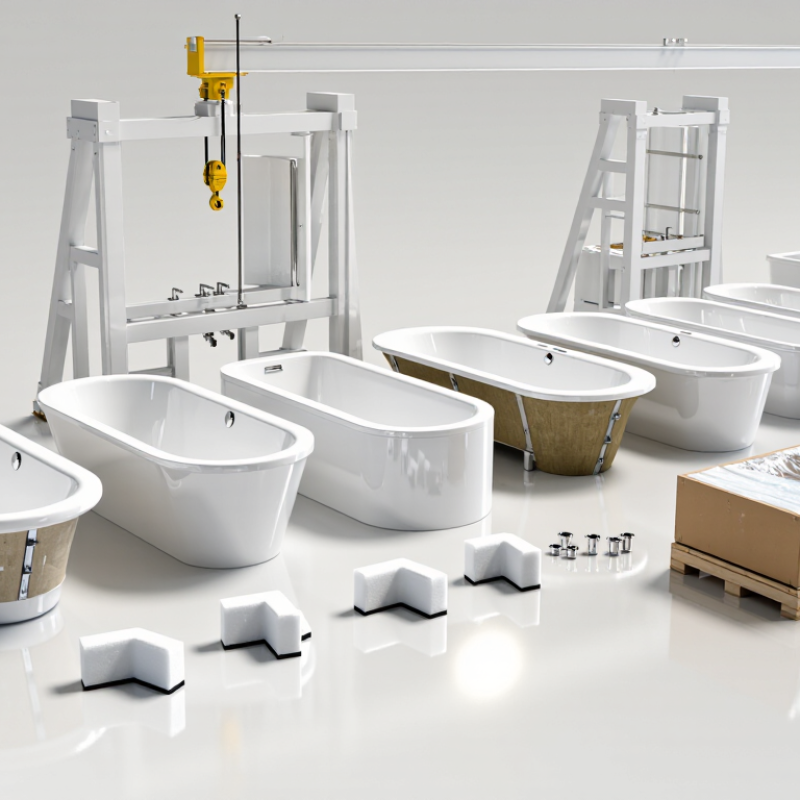
China Top 10 Acrylic Freestanding Bathtub Suppliers?

China’s Acrylic Bathtub Market: Capacity, Export Value, and Growth Data

China’s acrylic bathtub industry is export-oriented and highly concentrated in manufacturing clusters. China Customs data, classified under HS 392210, recorded roughly US$1.1 billion in Chinese exports of plastic baths, shower baths, sinks, and wash-basins in 2023. This category is broader than acrylic freestanding bathtubs. Treat it as a market proxy, not an exact product total.

Capacity remains difficult to measure. Public statistics rarely separate acrylic bathtubs from other plastic sanitary ware. Industry research indicates that China has several million units of annual bathtub capacity, supported by fiberglass forming, acrylic sheet production, CNC trimming, and automated polishing. Mordor Intelligence estimates the global bathtub market will grow at about 4% annually through the late 2020s. China’s export growth should benefit from renovation demand, hotel projects, and online bathroom retail.

The numbers need careful checking. A factory may report maximum capacity, not practical output during low seasons. Export data can also include small basins and shower products. For a top-ten supplier review, buyers should compare audited production records, monthly output, defect rates, mold ownership, and shipment history. A supplier claiming 100,000 units yearly deserves evidence. Photos are not enough. Procurement teams should request recent customs records and sample inspections before ranking capacity.

How to Rank the Top 10 Suppliers Using ISO, CE, and ASTM Criteria

To rank China’s top 10 acrylic freestanding bathtub suppliers, use evidence rather than catalog claims. The ISO Survey 2023 recorded more than 1.2 million ISO 9001 certificates worldwide. That number shows scale, not product quality. Check the certificate scope, issuing body, expiry date, and audited factory address.

Use ISO 9001 as the management baseline. Review incoming acrylic inspection, mold control, water testing, and corrective-action records. ASTM International reports more than 12,000 active standards, but ASTM compliance is not automatic. Request test reports for acrylic sheets, load resistance, surface durability, and drainage performance. The report must identify the tested material and production batch.

CE requires careful interpretation. Many standalone bathtubs do not automatically require CE marking. A supplier should explain the exact EU legislation, risk assessment, and Declaration of Conformity, when applicable. Do not reward a printed CE logo alone. That is weak evidence.

Create a 100-point score. Give 30 points to ISO systems, 25 to verified ASTM-related testing, and 20 to applicable CE documentation. Reserve 15 points for factory inspection and 10 for delivery records. Examine a real sample. Check the underside, reinforcement, overflow seal, and acrylic thickness with a gauge.

A perfect ranking is unrealistic. Reports can be outdated, translated poorly, or linked to another factory. I would lower a supplier’s score when documents look polished but samples show uneven gloss, flexing, or poor packaging. Independent retesting may cost more, yet it protects the ranking from attractive paperwork.

Acrylic Quality Metrics: Thickness, Gloss, Strength, and Water Absorption

When comparing China’s top 10 acrylic freestanding bathtub suppliers, material evidence matters more than polished showroom images. Finished acrylic thickness commonly falls between 4 and 8 millimeters, but thermoforming can reduce thickness around corners and the base. Request measurements from several points, not only the rim. A supplier’s inspection report should identify gauge accuracy and testing dates. In practice, uneven thickness often appears near the drain area.

Published PMMA technical data, tested under ASTM D638, commonly reports tensile strength near 60–75 MPa. That figure does not prove a bathtub will resist every impact. Reinforcement, bonding, and base support also affect real-world strength.

ASTM D523 measurements can place high-gloss acrylic above 70 gloss units at a 60-degree angle, although scratches and cleaning chemicals reduce this result. It looks impressive. It is not permanent.

Water absorption deserves equal attention. ASTM D570 and ISO 62 data for cast acrylic commonly show approximately 0.3–0.4% absorption after 24 hours, depending on grade and conditioning. Lower absorption usually supports better dimensional stability, but testing conditions must be disclosed. Ask for raw test values, sample thickness, and laboratory identification. I would not accept “premium acrylic” as a quality metric. One weakness in many comparisons is the lack of aging data, especially after repeated hot-water cycles. A careful buyer should request gloss retention, impact testing, and dimensional checks after conditioning.

Top 10 Chinese Suppliers Compared by MOQ, Lead Time, and Certifications

China Top 10 Acrylic Freestanding Bathtub Suppliers

Comparing ten Chinese suppliers requires more than checking product photos. Their minimum order quantities range from one sample to around twenty units. Low-MOQ suppliers suit boutique projects and replacement orders. Larger factories usually offer better pricing for container purchases. However, cheaper pricing can hide mold fees, packaging charges, or limited customization.

Typical production lead times range from 15 to 45 days after drawing approval and deposit payment. Standard white tubs often move faster than colored or textured models. Ask whether the lead time includes inspection and export packing. In my sourcing experience, a clear production schedule prevents more problems than a small price reduction. Delays still happen. Port congestion and mold adjustments remain difficult to predict.

Certification records also separate reliable suppliers from attractive listings. Look for ISO 9001 systems, material test reports, and market-specific approvals such as cUPC or WaterMark. SGS inspection reports can support quality checks, but they do not replace product certification. Confirm the report number, product model, and testing date directly. Request acrylic thickness data, reinforcement details, drain compatibility, and carton drop-test results. The comparison is not perfect. Some suppliers communicate well but provide weaker documentation, while others hold strong certificates but respond slowly. A practical shortlist should balance MOQ, lead time, factory evidence, and after-sales accountability.

OEM Pricing, Production Capacity, and Global Buyer Evaluation Factors

China Top 10 Acrylic Freestanding Bathtub Suppliers?

OEM pricing depends on more than the quoted bathtub price. Buyers should separate mold charges, acrylic thickness, reinforcement, packaging, and export terms. A low quotation may exclude drain fittings or reinforced pallet packaging. Ask for a cost breakdown and a repeat-order price. Production samples reveal more than a polished catalog. Check surface gloss, underside support, rim symmetry, and water drainage. Small flaws matter.

Production capacity should be verified with factory records, not promises. Request monthly output, active production lines, curing time, inspection procedures, and peak-season lead times. A supplier may claim large capacity while outsourcing key processes. That creates inconsistent color and delayed replacements. Review recent inspection reports and confirm whether the same facility makes the sample and bulk order. Capacity is useful only when quality remains stable.

Global buyers also evaluate communication, documentation, and delivery reliability. Confirm applicable product testing, electrical requirements for optional accessories, carton dimensions, and shipping marks for each destination. Ask how cracks, scratches, or missing parts are handled after arrival. Response speed matters. So does written evidence. A spreadsheet can look reassuring, yet it cannot show factory discipline. Independent inspections remain worthwhile, although they add cost and may slow shipment. Payment terms, minimum order quantity, spare-part availability, and clear warranty wording should be compared together, not separately.

China Acrylic Freestanding Bathtub Supplier Evaluation Model

This reference model converts common global-buyer priorities into normalized decision weights. OEM customization, quality compliance, and production capacity receive the highest weighting, while price is evaluated together with lead time, export capability, and after-sales support.

FAQS

How should suppliers be ranked fairly?

Use evidence, not showroom claims. A practical score has 100 points. Give 30 points for ISO systems, 25 for verified testing, and 20 for applicable CE documents. Reserve 15 points for factory inspection and 10 for delivery records. The ranking is useful, but never perfect.

What should an ISO 9001 certificate prove?

Check the certificate scope, expiry date, issuing body, and audited factory address. The scope should relate to bathtub production or relevant manufacturing activities. Review incoming acrylic inspection and mold-control records. Also check water tests and corrective-action reports. A certificate alone proves little.

Does every standalone bathtub need CE marking?

Not necessarily. The supplier should explain the exact applicable European legislation. Request a risk assessment and Declaration of Conformity when required. Do not reward a printed CE logo alone. That is weak evidence.

What testing documents should buyers request?

Request reports for acrylic sheets, load resistance, surface durability, and drainage performance. Each report should identify the tested material and production batch. Check the laboratory name, testing date, and test conditions. A polished report may still be outdated or poorly translated.

How should acrylic thickness be checked?

Measure several points with a thickness gauge. Check the rim, corners, base, and drain area. Finished acrylic commonly measures between 4 and 8 millimeters. Thermoforming can make corners and bases thinner. One measurement is not enough.

Which acrylic quality metrics matter most?

Examine thickness, gloss, strength, and water absorption together. Published PMMA data may show tensile strength near 60–75 MPa. That number does not guarantee impact resistance in a finished bathtub. Reinforcement, bonding, and base support also matter. The real sample decides more.

What water absorption information should suppliers provide?

Ask for raw values, sample thickness, conditioning details, and laboratory identification. Cast acrylic may show roughly 0.3–0.4% absorption after 24 hours. Lower absorption can support better dimensional stability. Testing conditions still matter. “Premium acrylic” is not a measurement.

What physical details should be inspected on a sample?

Inspect the underside, reinforcement, overflow seal, and acrylic thickness. Look for uneven gloss, flexing, weak bonding, or poor packaging. Check the drain area carefully. It often reveals uneven material thickness. I would request independent retesting when documents look unusually perfect.

Conclusion

China’s acrylic bathtub industry is expanding through growing domestic capacity, rising export activity, and increasing demand from residential, hospitality, and renovation projects. This guide explains how to evaluate the top suppliers of Acrylic Free Standing Bathtub products using practical criteria such as ISO, CE, and ASTM-related quality systems, while also examining acrylic thickness, surface gloss, structural strength, heat resistance, and water absorption. These indicators help buyers distinguish durable products from models that may lose their finish or stability over time.

The comparison also considers minimum order quantities, production lead times, OEM flexibility, certifications, manufacturing capacity, packaging, and communication efficiency. Instead of focusing only on the lowest quotation, global buyers should assess total value, including material consistency, mold accuracy, quality control, after-sales support, and delivery reliability. By balancing pricing with production capability and documented standards, importers, distributors, contractors, and project purchasers can make more confident sourcing decisions.

Amelia

Amelia

Amelia is a professional marketing specialist dedicated to helping businesses understand products, industries, and customer needs through clear, practical, and insight-driven communication. With a strong understanding of the company’s products, services, and market positioning, she transforms......