Expert guides, design inspirations, and technology innovations for luxury bathroom solutions.
Understanding auto-flush technology, heating controls, and ceramic durability.
Precision temperature management & wall-mounted brass fixture trends.
Multifunction digital integrated sinks redefining luxury home utility.
Choosing a kitchen faucet can look simple, but the wrong model quickly becomes frustrating. A Single Handle Pull Out Kitchen Faucet affects daily cooking, cleaning, and water control. This guide introduces seven practical tips for making a dependable choice. It focuses on real kitchen habits, not only attractive product photos.
Start with your sink size and countertop layout. A short spout may not reach every basin corner, while an oversized one can splash water onto nearby surfaces. Measure twice. I once selected a faucet that looked elegant but offered too little hose reach. That mistake made rinsing large pans unnecessarily difficult. A pull-out sprayer should extend smoothly, return securely, and resist awkward twisting. Check the hose weight and docking design before purchasing.
Material quality deserves careful attention. Look for solid brass or durable stainless steel components, a reliable ceramic cartridge, and clearly stated finish information. These details often matter more than a low price. Confirm the mounting-hole requirements, water-line connections, and installation instructions. Manufacturer warranty terms can also reveal how seriously a brand supports its product. Independent reviews are useful, but they should be compared with technical specifications and professional recommendations.
Think about maintenance, too. A removable aerator helps reduce mineral buildup, especially in hard-water areas. Fingerprint-resistant finishes may save cleaning time. The best choice balances reach, control, durability, appearance, and repair support. Some buyers focus too heavily on style. I did that once. A beautiful faucet is still a poor investment if its handle feels loose or its sprayer fails after months of use.
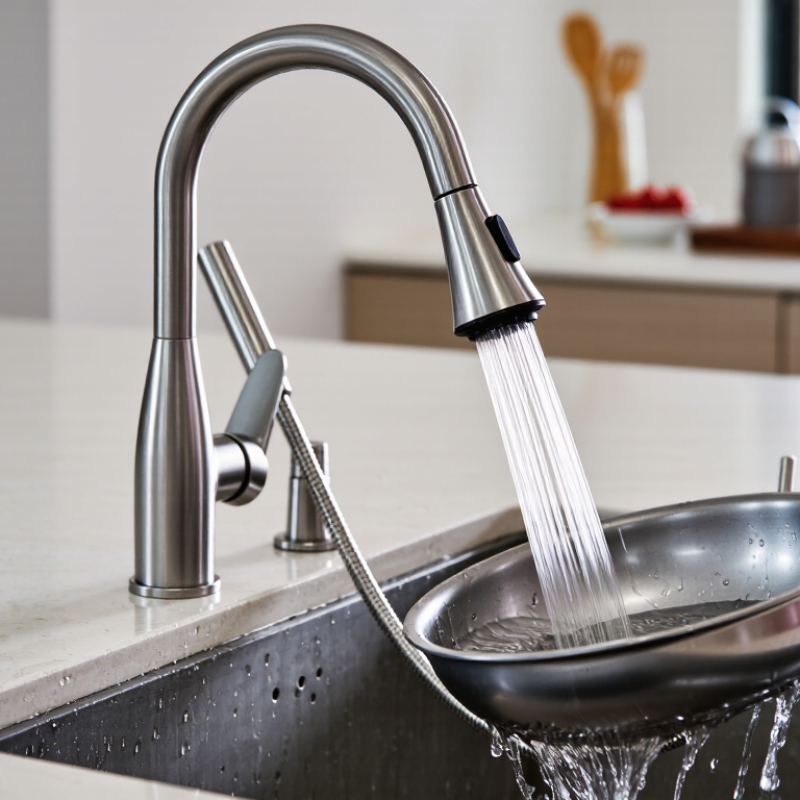
A single-handle pull-out faucet combines temperature control and spray movement in one compact design. Lift the handle for water, then move it left or right for temperature. The pull-out head slides toward you, which suits shallow sinks and narrow counters. Fit matters. Before choosing, measure the sink depth, backsplash clearance, and mounting-hole size.
Look inside the design, not only at its finish. A ceramic cartridge usually offers smoother control and better wear resistance than older compression mechanisms. The flexible hose should extend far enough to reach each basin corner without sharply bending. A secure docking system also matters; a loose spray head can swing, leak, or collect grime. The U.S. Environmental Protection Agency states that WaterSense-labeled kitchen faucets use no more than 1.8 gallons per minute, compared with the federal 2.2-gallon limit. That lower flow can reduce water use, but weak pressure may frustrate heavy cleaning.
Daily handling reveals problems that showroom displays hide. I once preferred a light pull-out hose, then noticed it resisted retraction when the cabinet was crowded. Check the counterweight, hose path, and shutoff access beneath the sink. The National Kitchen and Bath Association’s 2024 Kitchen Trends report identifies improved functionality as a major renovation priority, supporting practical faucet decisions over decorative choices. Still, reports cannot predict every household. Children, hard water, and frequent pot washing may change what feels convenient. Test the handle with wet hands if possible. Small detail. Big difference.
Sink compatibility should guide your choice before appearance. Check whether the sink has one mounting hole or three separate holes. A three-hole sink may need a matching cover plate for secure, neat installation. Measure the deck thickness as well. Some faucets cannot clamp safely onto thick stone or composite surfaces. Measure twice. That detail matters.
Confirm the faucet’s reach and height against your basin. The spout should direct water near the drain, not onto the rear wall. Check backsplash clearance before buying, especially when the handle moves backward. Pull-out hoses also need room beneath the sink. A tight cabinet can restrict movement and create annoying friction. I have seen beautiful fixtures fail because the hose brushed the plumbing lines.
Installation requirements deserve equal attention. Compare the faucet’s connectors with your existing shutoff valves, and inspect their condition. Old valves may leak after being disturbed. Turn off the water and keep a towel nearby. Follow the supplied mounting sequence, using only the recommended sealant. Overtightening can crack a sink or damage the gasket. I once underestimated cabinet space and had to reposition a filter system. That mistake was avoidable. When local plumbing rules or countertop drilling are involved, consult a qualified professional. Their advice can prevent expensive corrections.
Choosing a single-handle pull-out kitchen faucet starts with its material. Solid brass bodies usually resist heat, pressure, and repeated movement better than lightweight alloys. Stainless steel is also practical, especially near salty air or hard water. Plastic parts are not automatically poor, but thin threads and flexible connectors deserve caution.
Finish affects cleaning and long-term appearance. Brushed surfaces hide fingerprints better than polished chrome, while matte finishes can expose mineral spots. The U.S. Environmental Protection Agency reports that household leaks waste nearly one trillion gallons of water annually. A finish cannot prevent leaks, but smooth surfaces make residue easier to notice. I once valued appearance too highly. The faucet looked perfect, yet its spray head connection felt loose.
Build quality is easier to judge through details. Check the cartridge, hose weight, swivel joint, and connection threads. A metal pull-out hose guide should return smoothly without scraping the cabinet.
The EPA WaterSense specification limits qualifying kitchen faucets to 1.5 gallons per minute, helping control water use without sacrificing ordinary rinsing performance. Look for compliance with ASME A112.18.1/CSA B125.1 and NSF/ANSI 61, where applicable. These references indicate tested performance and safer water-contact materials.
Still, certification does not replace inspection. I would test the handle movement, spray-button response, and hose retraction before installation. Small defects matter.
Choosing a single-handle pull-out kitchen faucet starts with your sink, not its appearance. Measure the basin’s depth and the distance from the mounting hole to the drain. A hose that reaches every corner makes rinsing vegetables and cleaning stuck-on food easier. I once overlooked this measurement, and the spray barely reached the far side.
Check whether the faucet offers a steady stream, focused spray, and pause control. A strong spray can remove dried residue, while a softer stream protects delicate produce. The pause button is useful during dishwashing because it limits unnecessary water flow. Test the handle movement, too. It should adjust temperature smoothly, even with wet hands. Small details matter.
Water flow needs careful attention. Look for a clear flow-rate specification, then consider your home’s water pressure. A high-flow faucet may perform poorly in an older kitchen with narrow pipes. Removable aerators can help reduce splashing and simplify cleaning. Reach is not only about hose length; the spout should swivel without striking a wall or tall container. Check how the hose retracts. A weak docking system becomes irritating quickly. My preference has changed after using one that needed constant repositioning. Real use is less forgiving than a showroom display.
7 Tips for Choosing a Single Handle Pull Out Kitchen Faucet
Checking Maintenance Needs, Warranty, and Overall Value
A pull-out faucet should make daily work easier, not create another chore. Check whether the spray head detaches smoothly and returns without twisting the hose. Look for a replaceable cartridge, accessible aerator, and standard connection parts. These details reduce repair time when water flow weakens or the handle becomes stiff. I also inspect the hose path under the sink. A tight bend can cause trouble, even when the faucet looks excellent.
Ask how often the finish needs cleaning. A soft cloth may be enough, but hard-water stains can change that routine. Avoid designs with deep grooves around the handle, where soap and mineral residue collect. Test the handle with wet hands if possible. It should move firmly, not slide suddenly. This small check is easy to miss. I have overlooked it before.
Read the warranty instead of trusting the word “limited.” Confirm its length, covered components, labor terms, and exclusions for normal wear. Check whether replacement cartridges and hoses remain available after installation. A low price is less attractive when one small part requires a full faucet replacement. Compare the faucet, spare parts, installation effort, and expected service life together. The cheapest option may still be poor value. My judgment is not perfect, so I record these costs before deciding.
| Tip | Priority | What to Check | Practical Benchmark | Why It Matters for Maintenance, Warranty, and Value |
|---|---|---|---|---|
| 1 | High | Confirm sink and countertop compatibility Check the mounting-hole count, hole spacing, deck thickness, and available clearance below the sink. |
Most single-handle pull-out faucets use one mounting hole, but adapters may be needed for three-hole sinks. Verify the manufacturer’s published mounting range before purchase. | Correct fit prevents leaks, unstable installation, extra adapter costs, and return shipping. It also reduces the risk of voiding installation-related warranty coverage. |
| 2 | High | Evaluate the cartridge and internal seals Look for a ceramic cartridge, replaceable seals, and clearly documented replacement parts. |
Ceramic cartridges are widely used because they resist wear and can provide smooth temperature control when properly manufactured and maintained. | A replaceable cartridge can extend the faucet’s service life without replacing the entire unit. Confirm that parts are available separately and identify their expected cost. |
| 3 | High | Check spray-head cleaning requirements Inspect the nozzle design, removable aerator, and resistance to mineral buildup. |
Flexible silicone spray nozzles are easier to wipe clean. A removable aerator or screen simplifies flushing sediment and scale from the spray head. | Easy cleaning helps maintain water flow and spray performance, especially in areas with hard water. Avoid designs that require special tools for routine cleaning. |
| 4 | Medium | Assess hose movement and retraction Test the pull-out hose length, swivel range, docking method, and weight balance of the spray head. |
The hose should extend far enough to reach the main sink compartments and retract smoothly without rubbing against plumbing or stored items. | A well-designed hose reduces kinks, abrasion, and accidental drops. A secure docking system helps prevent the spray head from sagging over time. |
| 5 | High | Review the warranty terms carefully Compare coverage for the body, cartridge, finish, spray hose, and electronic components if included. |
Residential faucet warranties commonly range from a few years to limited lifetime coverage, but exclusions, proof-of-purchase rules, labor coverage, and finish terms vary. | A longer warranty is useful only when the claims process is practical. Check whether replacement parts, shipping, labor, corrosion, and damage caused by improper installation are covered. |
| 6 | Medium | Verify water-flow performance and efficiency Review the maximum flow rate and whether the faucet includes a pressure-compensating or flow-restricting aerator. |
Many modern kitchen faucets are rated at approximately 1.5 to 2.2 gallons per minute, depending on local requirements and the product configuration. | A lower flow rate can reduce water use while remaining practical for washing dishes. Make sure the flow is strong enough for the household’s needs and compatible with local plumbing pressure. |
| 7 | High | Calculate total ownership value Include the purchase price, installation supplies, replacement cartridges, filters or aerators, cleaning effort, and expected service life. |
Compare the complete cost over several years rather than judging value by the initial price alone. A moderately priced faucet with accessible parts may cost less to maintain. | Overall value combines reliable operation, simple maintenance, usable warranty coverage, repairability, water efficiency, and installation fit—not just the lowest purchase price. |
Buying reminder: Always confirm current specifications, installation instructions, replacement-part availability, and warranty exclusions in the product documentation before making a final decision.
Count the mounting holes before choosing a faucet. One-hole sinks usually suit single-handle designs. Three-hole sinks may need a matching cover plate. Measure the deck thickness, too. Measure twice.
Measure from the mounting hole to the drain and compare the spout reach. The water should land near the drain, not on the rear wall. A longer pull-out hose can help rinse corners. I once ignored this detail, and the spray barely reached the far side.
Check backsplash space, especially if the handle moves backward. Confirm that the spout can swivel without hitting a wall or tall container. Leave room beneath the sink for hose movement. Tight cabinets can cause friction.
Solid brass often handles heat, pressure, and repeated movement well. Stainless steel can suit salty air or hard water. Plastic parts are not automatically weak. Thin threads and flexible connectors deserve closer inspection.
Brushed surfaces usually hide fingerprints better than polished surfaces. Matte finishes may show mineral spots clearly. Smooth surfaces make residue easier to notice. Appearance still matters, but I once valued it too highly.
A steady stream suits filling containers and ordinary rinsing. A focused spray helps remove dried food. A softer stream protects delicate produce. A pause button can reduce water use during dishwashing. Small details matter.
Check the stated flow rate and consider your home’s water pressure. Older pipes may perform poorly with demanding flow requirements. Test whether the hose returns smoothly without scraping the cabinet. A weak docking system becomes irritating quickly.
Compare the faucet connectors with your shutoff valves before installation. Inspect old valves because disturbing them may reveal leaks. Turn off the water and keep a towel nearby. Use only recommended sealant. Overtightening can crack the sink or damage the gasket.
Look for relevant safety and performance certification for kitchen water fixtures. Certification does not replace a physical inspection. Test the handle, spray button, hose, and mounting stability. Consult a qualified professional when drilling stone or local plumbing rules are involved. Mistakes become expensive.
Choosing the right Single Handle Pull Out Kitchen Faucet starts with understanding its design, including how the pull-out spray head operates and whether the handle offers smooth, precise control. Before purchasing, check your sink’s mounting holes, countertop thickness, available space, and plumbing connections to ensure a straightforward installation. The faucet’s height and hose length should also match your sink and kitchen layout.
Pay close attention to construction materials, finish durability, and overall build quality, as these factors affect appearance and long-term performance. Compare spray settings, water flow, swivel range, and hose reach to find a model suited to everyday tasks such as rinsing dishes and cleaning the sink. Finally, consider maintenance requirements, cartridge and aerator access, warranty coverage, replacement parts, and total cost. A well-balanced choice should provide reliable performance, easy cleaning, practical features, and lasting value without unnecessary complexity.