Expert guides, design inspirations, and technology innovations for luxury bathroom solutions.
Understanding auto-flush technology, heating controls, and ceramic durability.
Precision temperature management & wall-mounted brass fixture trends.
Multifunction digital integrated sinks redefining luxury home utility.
Choosing the right Stainless Steel Multifunction Kitchen Sink can change how smoothly your kitchen works each day. It is more than a basin for washing dishes. It may become a preparation station, draining area, and storage point for essential tools.
In real kitchens, small details matter. A deep bowl can hold a large roasting pan without splashing water across the counter. A built-in colander may help rinse vegetables beside a cutting board. A sturdy ledge can support a drying rack, but only if its dimensions match your workspace. These features sound useful. They are not always practical for every household.
Material quality deserves careful attention. Look for food-safe stainless steel, strong welding, and a finish that hides light scratches. Thicker steel often feels quieter and more stable, although thickness alone does not guarantee excellent construction. Insulation pads can reduce noise when water hits the bowl. A well-designed drain should also empty efficiently, without leaving a shallow puddle near the strainer.
Your cabinet size, plumbing position, and cooking habits should guide the decision. Measure the opening twice. A beautiful sink cannot compensate for an incorrect installation size. Consider bowl depth, faucet compatibility, corner space, and cleaning access. Some multifunction accessories are convenient, while others may occupy drawers after a few weeks. I have seen buyers focus on appearance and overlook maintenance. That mistake is easy to repeat.
This guide examines practical features, material standards, installation concerns, and long-term value. It also questions marketing claims, because more accessories do not always create a better kitchen. The best choice should feel dependable during busy mornings, careful meal preparation, and ordinary cleanup.
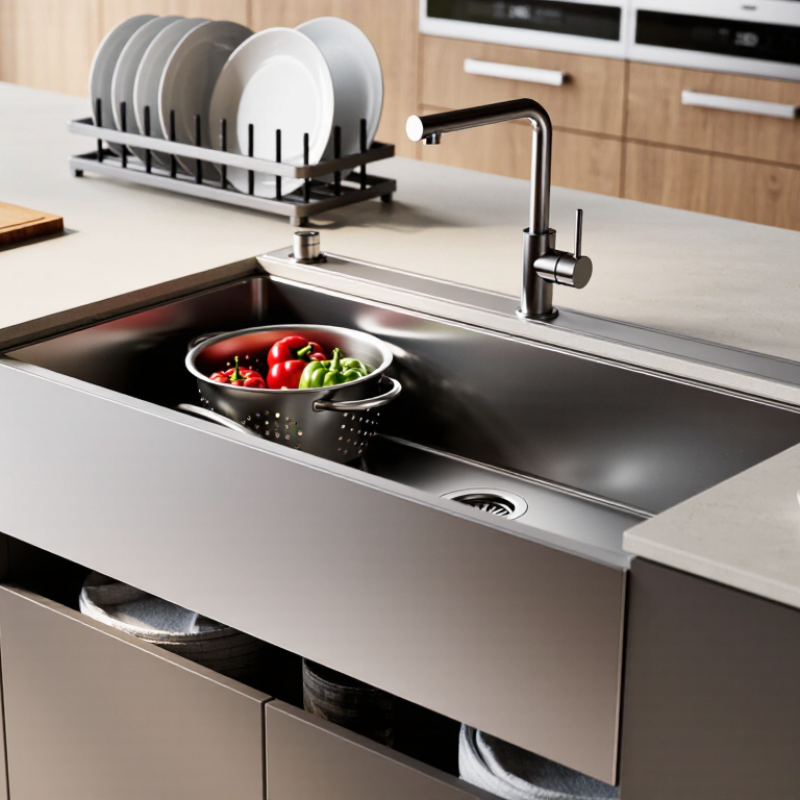
A stainless steel multifunction kitchen sink is more than a deep basin. It combines washing, rinsing, draining, and food preparation in one workstation. Many models include sliding colanders, cutting boards, drying racks, and separate ledges. These accessories move across the bowl and create a more organized workflow.
Material quality matters. The Nickel Institute describes 304 stainless steel as an 18% chromium and 8% nickel alloy. This composition supports corrosion resistance and everyday durability.
The International Stainless Steel Forum reported global stainless steel crude production at about 58.4 million tonnes in 2023. That scale reflects stainless steel’s broad use, but it does not guarantee every sink has equal quality.
Gauge, welding, surface finish, and sound insulation still require inspection. A thicker sink usually feels less resonant, although thickness alone can mislead.
Tips: Check the accessory fit before buying. Slide each part across the ledges. Measure cabinet width, bowl depth, and faucet clearance. A 304-grade sink suits many homes, while harsh coastal conditions may justify comparing 316-grade options. One practical weakness is often ignored: too many accessories can crowd the basin. Choose the tools you will actually use.
How to Match Sink Size and Configuration to Your Kitchen
Sink choice should begin with cabinet width, not appearance. Measure the base cabinet inside, then confirm the sink’s minimum cabinet requirement. A 30-inch cabinet often suits a compact 25-inch sink, while a 36-inch cabinet can support a larger single-bowl or workstation model. Leave enough counter space for cutting boards and hot cookware.
The National Kitchen and Bath Association’s Kitchen Planning Guidelines recommend at least 24 inches of counter space on one side of the sink and 18 inches on the other. These clearances create safer landing zones during meal preparation. A single deep bowl works well for large pans and simplifies cleaning. A double bowl improves separation, but each compartment becomes narrower. I once underestimated faucet reach; the water landed too close to the rear wall. Small details matter.
Tips: Use your daily cookware as a test. Place a stockpot, baking tray, and colander near the proposed sink area. Check whether cabinet doors, dishwasher doors, and walkways conflict. For a narrow kitchen, choose a shorter sink with a rear-positioned drain. For a busy household, consider a multifunction sink with an integrated ledge, but verify its accessories and cleaning needs. The 2024 Houzz U.S. Kitchen Trends Study shows that homeowners continue investing heavily in kitchen upgrades, yet expensive fittings cannot fix poor planning. Measure twice. Then question the layout.
Match the sink configuration to the available cabinet width and the way your kitchen is used. The chart shows common sink widths and the approximate minimum base-cabinet widths typically required for installation.
Compact kitchens commonly use a 24-inch single-bowl sink, while standard kitchens often accommodate 30- or 36-inch double-bowl or multifunction sinks. Larger 42-inch workstation sinks require more cabinet space and are better suited to spacious family or entertaining kitchens. Always verify the manufacturer’s cutout dimensions, cabinet construction, plumbing position, and faucet clearance before installation.
Grade selection matters more than a polished sales description. World Stainless reported 58.4 million tonnes of crude stainless steel production in 2023, showing the material’s broad industrial use. However, not every grade suits a busy kitchen.
Type 304 remains a practical choice for most homes. It typically contains about 18% chromium and 8% nickel, supporting strong corrosion resistance around water, food acids, and detergents.
Type 316 adds roughly 2–3% molybdenum. That extra element improves resistance to chlorides, which matters near coastal air or salty cleaning water.
Type 430 contains chromium but usually little or no nickel. It costs less and is magnetic, yet it can show tea staining sooner in harsh conditions.
Real kitchens are less predictable than laboratory tests.
Surface finish changes daily maintenance. A 2B finish is smooth and understated, while a No. 4 brushed finish hides light scratches better. Deep brushing can still trap grease if cleaning follows the grain poorly. Avoid choosing by appearance alone.
Look for consistent welds, rounded corners, and a finish that feels even under your fingertips. ASTM A480 identifies common stainless surface finishes, but suppliers may interpret visual grades differently. Ask for the exact grade, thickness, and finish specification. A thicker bowl may reduce drumming, although thickness alone cannot fix weak support or poor installation.
A multifunction stainless steel sink should support real kitchen routines, not just display extra accessories. Check whether the cutting board sits firmly over the basin. It should not slide when chopping vegetables. A colander is useful for rinsing, but its rim must match the sink securely. Loose parts quickly become frustrating.
Tips: Test each accessory before buying. Lift the racks. Inspect the welds. Look for rounded corners and removable drain baskets. Measure your cabinet opening carefully, including plumbing space. I once chose a deep basin that looked practical, but it reduced legroom beneath the counter. That mistake was avoidable.
Evaluate cleaning and durability with equal care. Stainless steel with a brushed surface can hide small scratches, while polished surfaces show water marks more clearly. Confirm the steel grade, thickness, sound insulation, and resistance to household cleaners. A drying rack should drain into the basin, not onto the countertop. Check whether replacement accessories are available without relying on one seller. The design may seem clever. It might still create narrow areas where food collects. Before installation, verify faucet-hole positions, overflow details, and local plumbing requirements with a qualified installer. Practical testing matters more than a long accessory list.
A multifunction stainless steel kitchen sink earns its value through careful installation. Before ordering, measure the cabinet, countertop opening, drain position, and faucet holes. A sink may fit the counter but still conflict with pipes or storage space. I once underestimated cabinet support, and the basin shifted slightly after repeated use. That small mistake created a persistent seal problem. The installer should check the mounting clips, leveling, drainage slope, and silicone seal before connecting the water supply.
Daily maintenance is simple, but consistency matters. Rinse away salt, coffee grounds, and acidic food residue after use. Dry the surface with a soft cloth to reduce water spots. Use a non-abrasive cleaner and follow the grain when wiping brushed stainless steel. Avoid steel wool and do not leave chlorine-based cleaners sitting on the surface. They can damage the protective layer. Small scratches are normal.
Long-term value depends on more than appearance. Check the steel thickness, welded corners, sound-absorbing pads, drain quality, and replaceable accessories. A deep basin is useful, but it may cause back strain if the counter is low. A built-in colander or cutting board saves space, yet loose accessories can become awkward to store. Review the warranty terms and drainage parts before purchase. No sink stays perfect. Good design simply makes cleaning, repairs, and everyday work less troublesome.
| Evaluation Dimension | What to Check | Practical Data or Benchmark | Why It Matters | Long-Term Value Indicator |
|---|---|---|---|---|
| Stainless Steel Grade | Confirm the steel grade in the product specification or technical documentation. | Type 304 stainless steel contains approximately 18% chromium and 8% nickel. Type 316 adds molybdenum and generally offers better resistance to chlorides and salt exposure. | Higher corrosion resistance helps reduce staining, pitting, and premature surface damage. | Choose 304 for most indoor kitchens; consider 316 where salt air, coastal conditions, or chloride exposure is a significant concern. |
| Material Thickness | Check the actual sheet thickness in millimeters rather than relying only on gauge labels. | Common residential sink thicknesses are approximately 1.0–1.5 mm. Gauge numbers are not fully standardized across all manufacturers, so millimeter measurements are more reliable. | Thicker material usually provides greater rigidity, lower vibration, and better resistance to denting. | A rigid bowl is less likely to flex around the drain or develop seal problems over time. |
| Sink Configuration | Compare bowl count, bowl depth, divider height, drain position, and accessory compatibility. | Single bowls often provide more uninterrupted space for large cookware. Double bowls separate washing and rinsing but may limit usable width. Typical residential bowl depths are about 180–250 mm. | The configuration should match cookware size, food-preparation habits, and available cabinet space. | A suitable layout reduces daily workarounds and makes the sink useful for many years. |
| Multifunction Accessories | Check whether the ledges, rails, cutting board, colander, drying rack, and drain components fit securely. | Useful accessories should be removable for cleaning and should not obstruct the faucet, drain, or bowl opening. | Well-fitted accessories can create separate washing, rinsing, draining, and preparation zones. | Replaceable and standardized accessories are more valuable than permanently integrated parts that are difficult to repair. |
| Installation Type | Select top-mount, undermount, or flush-mount installation according to the countertop and cabinet design. | Top-mount sinks rest on the countertop; undermount sinks attach below the counter; flush-mount sinks are installed nearly level with the work surface. | The installation method affects support, cleaning, appearance, and future replacement difficulty. | Top-mount models are generally easier to replace; undermount models provide easier countertop wiping but require accurate fabrication and sealing. |
| Cabinet and Cutout Fit | Measure cabinet width, countertop thickness, cutout dimensions, bowl depth, plumbing clearance, and faucet-hole spacing. | The sink must fit the cabinet without interfering with drawers, disposal equipment, water lines, or waste pipes. Use the installation template supplied for the specific sink. | A dimensional mismatch can require countertop modification or prevent proper support and sealing. | Accurate measurements reduce installation costs and make future replacement more straightforward. |
| Drain Compatibility | Verify drain opening size, strainer type, waste-pipe connection, and compatibility with a food-waste disposer if used. | A 3.5-inch drain opening is common for many kitchen sinks, but local plumbing standards and the sink specification must be confirmed. | Correct drain alignment supports reliable water flow and reduces leakage risk. | Standard, replaceable strainers and seals are easier and less expensive to maintain. |
| Mounting Support | Inspect mounting clips, brackets, support rails, and the recommended sealant system. | Undermount sinks require continuous, properly prepared support; heavy sinks should not rely on sealant alone. | The sink may hold substantial water and cookware weight, so secure support is essential. | Strong mounting minimizes movement, cracked seals, countertop damage, and water intrusion into cabinetry. |
| Sound Control | Look for bonded sound-deadening pads or a sprayed coating on the underside, particularly beneath the bowl. | Sound pads reduce vibration from running water, dishes, and waste-disposal equipment, although they do not eliminate noise completely. | Reduced vibration improves comfort in open-plan kitchens and helps limit rattling. | Securely bonded, moisture-resistant pads are preferable to loose material that can detach. |
| Surface Finish | Compare brushed, satin, or polished finishes and inspect for uniform grain, sharp edges, and visible weld marks. | Brushed and satin finishes generally disguise everyday water spots and fine scratches better than highly polished surfaces. | A consistent finish is easier to clean and typically maintains a neat appearance with regular care. | A repairable, non-coated stainless surface avoids the risk of a decorative coating peeling away. |
| Corner Radius and Drainage | Check whether corners are rounded enough for cleaning and whether the bowl floor slopes toward the drain. | Tighter corners may provide a modern appearance but can be harder to wipe. A properly formed floor should avoid persistent standing water. | Good drainage limits residue, odors, mineral deposits, and cleaning effort. | Easy-to-clean geometry reduces ongoing maintenance time and helps preserve the finish. |
| Daily Maintenance | Rinse food residue, wipe with mild dish soap, and dry the surface after use. | Wiping in the direction of the brushed grain helps reduce visible streaks. Soft cloths or non-abrasive sponges are suitable for routine cleaning. | Regular drying reduces water spots and buildup from minerals in hard water. | Simple daily care can preserve appearance without specialized cleaning products. |
| Stain and Scale Removal | Use a cleaner suitable for stainless steel and rinse thoroughly after treatment. | Diluted white vinegar can help dissolve mineral deposits, but it should not be left on the surface for extended periods and must be rinsed away. | Prompt removal of deposits reduces discoloration and prevents residue from becoming harder to remove. | Avoiding harsh chemicals helps prevent surface damage and unnecessary replacement. |
| Chemical Compatibility | Keep chlorine bleach, chlorides, strong acids, abrasive powders, and steel wool away from the stainless surface. | Chloride-containing substances can contribute to pitting corrosion, especially when concentrated or left on the surface. | Proper chemical handling protects the passive chromium-oxide layer that gives stainless steel its corrosion resistance. | A sink that remains undamaged under normal household care retains both function and appearance longer. |
| Leak Inspection | After installation, fill the bowls, drain them, and inspect the strainer, trap, supply connections, and cabinet underside. | Repeat the inspection after the first several uses and whenever a drain component is removed or replaced. | Small leaks can damage cabinets, flooring, insulation, and stored household items. | Early detection usually means replacing an inexpensive seal rather than repairing water damage. |
| Warranty and Parts | Review coverage for the bowl, finish, mounting hardware, strainers, accessories, and replacement parts. | A useful warranty should clearly state duration, exclusions, installation requirements, and the process for obtaining parts. | Accessories and seals are wear items and may need replacement before the stainless bowl itself. | Documented parts availability is a stronger long-term benefit than warranty length alone. |
| Environmental Durability | Consider exposure to salt air, hard water, acidic foods, cleaning chemicals, and frequent heavy use. | Type 304 is widely used for indoor food-service and residential applications; more aggressive chloride environments may justify a higher-alloy grade. | The operating environment affects corrosion risk more than appearance alone may suggest. | Matching the material to the environment can extend useful service life and reduce replacement frequency. |
| Total Cost of Ownership | Compare purchase price, fabrication, installation, plumbing changes, accessories, cleaning supplies, and possible repairs. | Total cost can be viewed as: purchase price + installation + modifications + maintenance and replacement parts over the expected service period. | The lowest initial price may not be the lowest overall cost if the sink requires difficult installation or unavailable parts. | Prioritize corrosion resistance, proper fit, repairable components, and a configuration that will remain useful as household needs change. |
Selection rule: Choose the sink that fits the cabinet and countertop first, matches the local environment second, and offers durable construction, serviceable components, and a practical layout within the total installation budget.
It combines washing, rinsing, draining, and food preparation in one workstation. Sliding boards and racks move across the basin.
304 stainless steel contains about 18% chromium and 8% nickel. It usually resists corrosion and daily wear. Quality still varies.
Measure the cabinet opening, bowl depth, countertop space, drain position, and faucet clearance. Also check plumbing space underneath.
Slide the cutting board, colander, and rack across the ledges. They should fit firmly and move without catching.
Yes. Extra tools may crowd the basin and create narrow areas for food. Choose accessories you will actually use.
Confirm cabinet support, mounting clips, leveling, drainage slope, and silicone sealing. A sink can fit the counter but still conflict with pipes.
Rinse away salt, coffee grounds, and acidic residue after use. Dry it with a soft cloth. Follow the grain with a non-abrasive cleaner.
Avoid steel wool and prolonged contact with chlorine-based cleaners. Small scratches are normal. Perfect surfaces are unrealistic.
Not necessarily. It may reduce storage space or cause back strain when the counter is low. I once overlooked cabinet support, and the basin shifted slightly.
Choosing a Stainless Steel Multifunction Kitchen Sink requires more than comparing appearance and price. First, understand that it combines a durable stainless steel basin with practical accessories or integrated work areas, such as cutting boards, draining racks, colanders, and rinse zones. Measure your cabinet space, countertop depth, and plumbing position before selecting the sink size and configuration. Consider whether a single, double, or multi-zone basin best suits your cooking habits and available workspace.
Material quality also matters. A suitable stainless steel grade should offer corrosion resistance, strength, and easy cleaning, while the surface finish should balance appearance with resistance to scratches and water marks. Evaluate each accessory for secure fitting, convenient storage, and everyday usefulness rather than choosing unnecessary extras. Finally, confirm installation requirements, drainage compatibility, sound insulation, and maintenance needs. A well-designed sink should be easy to clean, comfortable to use, and durable enough to provide long-term value in your kitchen.