Bathware Knowledge Base

Latest Bathware Insights & Industry News

Expert guides, design inspirations, and technology innovations for luxury bathroom solutions.

Buying Guides

Smart Toilet Buying & Selection Guides

Understanding auto-flush technology, heating controls, and ceramic durability.

Technical Insights

Thermostatic Shower Engineering

Precision temperature management & wall-mounted brass fixture trends.

Design Trends

Modern Kitchen & Waterfall Sink Articles

Multifunction digital integrated sinks redefining luxury home utility.

0%

Choosing a Black Stainless Steel Matt Shower Panel involves more than matching a bathroom color scheme. The surface should look elegant, but it must also handle daily water, soap residue, and repeated cleaning. A reliable panel needs solid construction, stable water pressure, and fittings that resist corrosion. These details matter more than a dramatic showroom photograph.

Start by checking the panel’s stainless steel grade, finish quality, and installation requirements. A matte black coating should appear even under bright bathroom lighting, without thin edges or visible patches. Run your fingers across the surface if possible. It should feel smooth, not powdery or rough. Confirm the inlet size, included accessories, and compatibility with your existing plumbing before ordering. This simple check can prevent an expensive installation mistake.

Water outlets deserve careful attention. Look for adjustable body jets, a practical overhead shower, and a hand shower with a flexible hose. More functions do not always create a better experience. Some panels look impressive but provide weak flow when several outlets operate together. That disappointment is easy to miss online. Manufacturer specifications, warranty terms, and verified customer feedback offer stronger evidence than attractive claims. I would also ask how the finish should be cleaned, because harsh chemicals may damage matte coatings. A soft cloth and mild cleaner are usually safer, but the manufacturer’s instructions should guide the final decision. The best Black Stainless Steel Matt Shower Panel balances appearance, comfort, maintenance, and dependable performance. It may not be the cheapest choice, yet thoughtful selection can make the difference between lasting satisfaction and frequent regret.
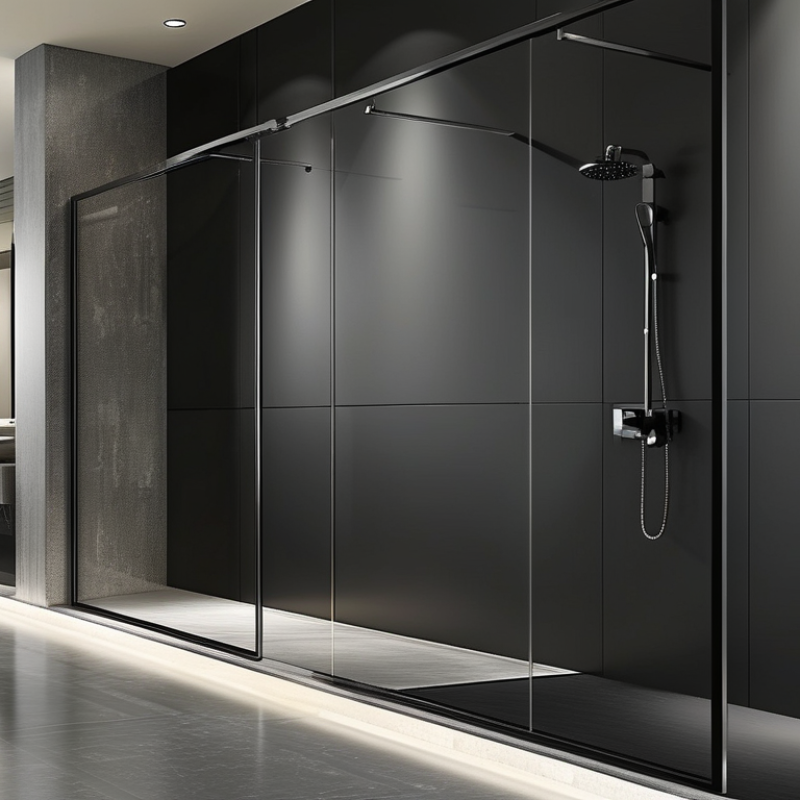
How to Choose a Black Stainless Steel Matt Shower Panel?

Define Your Shower Needs and Available Installation Space

How to Choose a Black Stainless Steel Matt Shower Panel?

Define Your Shower Needs and Available Installation Space

Start with the shower’s daily job, not its color. Measure the wall width, ceiling height, and clear space around the entrance. NKBA planning guidance commonly uses 30 by 30 inches as a minimum shower footprint. That size can feel restrictive when two outlets, body jets, or a shelf compete for space. Mark the panel’s height with masking tape. Check whether the controls remain reachable without standing under hot water.

Water performance also needs careful attention. The U.S. EPA WaterSense specification limits labeled showerheads to 2.0 gallons per minute at 80 psi. A panel with several outlets may divide that flow, reducing pressure at each outlet. Check your home’s static pressure and pipe size before choosing multiple sprays. A pressure-balancing or thermostatic valve can improve temperature stability, while local plumbing rules still control the final installation.

Matte black stainless steel can suit a compact, modern enclosure, but fingerprints and mineral spots remain visible under side lighting. Wipe a sample with your actual bathroom cleaner. Do not assume every dark finish reacts equally. For shared bathrooms, place the hand shower on an adjustable rail and keep the controls outside the main splash path. One detail is easy to miss: the panel may fit the wall, yet its connections may not match existing pipe centers. A plumber should verify those measurements before drilling. A beautiful fit can still become an expensive correction.

Compare Black Stainless Steel Finishes and Corrosion Resistance

Choosing a black stainless steel matte shower panel requires more than matching bathroom colors. The finish affects appearance, cleaning, and long-term corrosion resistance. A PVD finish bonds a colored layer to stainless steel through a controlled process. It usually resists scratching better than ordinary painted coatings. Powder coating can also look attractive, but damage may expose the metal beneath. Matte surfaces hide fingerprints and small water marks. They can still collect mineral residue.

Check the stainless steel grade before judging the finish. Grade 304 works well in many residential bathrooms. Grade 316 offers stronger resistance in humid or salty environments because it contains molybdenum. However, neither grade is completely rust-proof. Inspect welds, corners, screw holes, and water outlets carefully. These areas often reveal poor polishing or weak protective treatment. Ask for coating thickness, adhesion results, and corrosion test information. Vague claims are not enough.

Daily care matters more than many buyers expect. Rinse the panel after use and dry it with a soft cloth. Use a mild, pH-neutral cleaner. Avoid chlorine bleach, abrasive pads, and strong acidic descalers, which can dull the black surface. In my experience, hard-water bathrooms need more frequent cleaning, even with a premium finish. I once assumed a darker matte texture would hide everything. It did not. Small mineral spots became visible around the spray outlets, so finish quality and maintenance must be considered together.

Check Panel Features, Plumbing Compatibility, and Installation Method

Choosing a matte black stainless steel shower panel starts with its features, not its appearance. Look for a thermostatic or pressure-balancing valve, an anti-scald stop, and clearly stated flow rates. A panel with body jets, a rain head, and a hand shower may feel luxurious, but it also demands adequate water pressure. The U.S. EPA WaterSense specification limits qualifying showerheads to 2.0 gallons per minute. It estimates that an average family can save about 2,700 gallons of water annually with efficient showerheads. More outlets can reduce the actual spray strength.

Plumbing compatibility deserves careful checking. Measure the existing hot and cold pipe centers, connection size, wall depth, and available pressure. Confirm whether the panel uses exposed plumbing or requires a concealed valve body. Some models need reinforced wall framing, especially when several outlets share one control. ASSE 1016 and ASSE 1069 standards provide useful references for pressure-balancing and thermostatic shower controls. A licensed plumber should verify local requirements before drilling tiles. I still check twice. One wrong measurement can create an expensive repair.

Installation method also affects long-term reliability. Exposed panels are usually easier to service, while concealed systems create a cleaner profile but offer less access. Use flexible connections only when permitted, and pressure-test every joint before sealing the wall. Matte black finishes hide fingerprints, yet mineral spots remain visible on dark surfaces. The U.S. Geological Survey notes that hard water commonly contains calcium and magnesium, which can form scale around spray nozzles. A removable filter and wipeable silicone nozzles help, although neither eliminates maintenance. In practice, I would choose service access over a slightly slimmer design.

How to Choose a Black Stainless Steel Matt Shower Panel

The chart shows typical water-flow ranges for common shower-panel outlets. Actual flow depends on water pressure, pipe size, restrictors, and the product specification.

  • Panel features: Look for corrosion-resistant stainless steel, an even matt finish, easy-clean silicone nozzles, and independently controlled outlets.
  • Plumbing compatibility: Check the required inlet size, hot-and-cold water connections, operating pressure, and total flow demand before purchase.
  • Installation method: Concealed plumbing usually requires wall preparation, while exposed connections are easier to access and maintain. Confirm the mounting height and connection positions in advance.

Evaluate Dimensions, Water Performance, Safety, and Maintenance

Choosing a black stainless steel matte shower panel starts with accurate measurements. Measure the wall width, ceiling height, and existing pipe positions. Leave enough clearance for elbow movement and door operation. A panel that looks compact online may feel bulky in a narrow bathroom. Check the inlet spacing before buying. Small errors become expensive after tiling.

Water performance matters every day. Confirm the required water pressure and flow rate in the product specifications. A wide overhead shower can feel weak when several outlets run together. Look for separate controls for temperature and water volume. An anti-scald function adds practical protection, especially for children and older users. Use a qualified plumber when changing concealed connections. Local plumbing requirements may also affect installation.

Safety and maintenance deserve equal attention. Choose secure mounting, smooth control movement, and surfaces without sharp exposed edges. Matte black finishes hide fingerprints, but they can reveal dried mineral spots. Wipe the panel after use with a soft cloth and mild, non-abrasive cleaner. Avoid steel wool, acidic chemicals, and rough sponges. I once ignored a small drip near a connector; the stain became harder to remove later. That mistake was avoidable.

Tips: Test the water pressure before installation. Keep the fitting guide nearby. Check seals after the first week. Rethink the layout if controls feel awkward to reach.

Verify Quality, Warranty Coverage, and Overall Value within Your Budget

How to Choose a Black Stainless Steel Matt Shower Panel?

A quality shower panel should feel rigid, not hollow or flexible. Look for 304 stainless steel, precise welds, and a smooth PVD finish. The surface should resist fingerprints, but no coating is scratch-proof. Check the cartridge, hose connections, and spray outlets for replaceable parts. A product page alone is not enough. Request pressure-test results or installation records when available. That small step can reveal poor workmanship.

Budget value includes future costs. The U.S. EPA WaterSense specification limits certified showerheads to 2.0 gallons per minute, compared with the federal 2.5-gallon limit. Lower flow can reduce water and heating expenses without sacrificing comfort. The U.S. Department of Energy reports that water heating uses about 18% of household energy. Compare the panel’s flow rate, spare-part prices, installation fees, and return policy. Warranty coverage should clearly state parts, labor, finish damage, and exclusions. A long warranty means little if labor is excluded.

Tips: Ask for a written warranty before payment. Confirm the finish warranty separately. Measure wall connections carefully. Check whether replacement cartridges remain available. Do not overvalue decorative lighting. It may fail before the plumbing does. I would accept a small cosmetic flaw before trusting an impressive panel with weak seals. Even careful research can miss installation problems, so hire a qualified plumber for concealed connections.

How to Choose a Black Stainless Steel Matt Shower Panel? – Verify Quality, Warranty Coverage, and Overall Value within Your Budget

Evaluation Profile Typical Budget Recommended Panel Size Material and Finish Water Outlet Configuration Required Water Pressure Quality Verification Points Warranty Coverage to Seek Expected Service Life Overall Value
Essential / Entry-Level US$180–US$350 Approximately 39–47 in high × 6–8 in wide 304 stainless steel body preferred; matte black powder coating or PVD finish. Confirm that the finish is corrosion-resistant and not only painted plastic. 1 overhead rain shower, 1 hand shower, and 2–4 body jets. Usually 2.0–3.0 bar (29–44 psi) for satisfactory spray performance.
  • Body thickness and mounting plate should feel rigid.
  • Check for uniform color, complete edge coverage, and smooth welds.
  • Confirm that hoses and connectors use standard plumbing sizes.
  • Look for ceramic or stainless-steel cartridges rather than low-grade plastic valves.
At least 1 year for manufacturing defects, with clear exclusions for installation damage, limescale, and improper maintenance. Approximately 3–5 years with regular cleaning and correct installation. Best for tight budgets
Balanced / Mid-Range US$350–US$700 Approximately 43–55 in high × 7–10 in wide 304 stainless steel is standard; 316 stainless steel is advantageous in coastal or high-humidity locations. PVD matte black generally offers better wear resistance than paint. 1 overhead rain shower, 1 hand shower, 4–6 body jets, and a thermostatic or ceramic control valve. Approximately 2.5–4.0 bar (36–58 psi); verify the minimum pressure stated in the installation guide.
  • Request material documentation or a product specification sheet.
  • Check that the panel has concealed or protected water connections.
  • Verify that body jets have rubber nozzles for easier limescale removal.
  • Confirm independent controls for overhead, hand, and body outlets.
  • Check that replacement cartridges and hoses are available.
Preferably 2–5 years for the main body and valves, with separate terms clearly stated for finish, seals, cartridges, and accessories. Approximately 5–8 years when water quality is moderate and maintenance is consistent. Strongest overall value
Premium / High-Performance US$700–US$1,500+ Approximately 47–63 in high × 8–12 in wide 316 stainless steel is preferred for demanding environments; a certified PVD matte black finish should resist normal abrasion, moisture, and mild bathroom cleaners. Large overhead rain shower, hand shower, 6–8 body jets, thermostatic control, diverter valve, and optional tub-spout outlet. Approximately 3.0–5.0 bar (44–73 psi); confirm that the household water system can support multiple outlets operating simultaneously.
  • Review independent finish, leak, and pressure-test information where available.
  • Inspect internal valve quality, anti-scald protection, and temperature stability.
  • Confirm that all water paths are flushable and accessible for maintenance.
  • Check spare-part availability and installation support before purchase.
  • Verify that the mounting structure can safely support the panel weight.
Preferably 5 years or longer for the body and valves, with documented parts availability and a defined process for finish and cartridge claims. Approximately 8–12 years when professionally installed and properly maintained. Best long-term specification
Coastal or Hard-Water Use US$500–US$1,200+ Approximately 43–55 in high × 7–10 in wide 316 stainless steel body recommended for salt-air exposure; choose a high-quality PVD finish and avoid abrasive cleaners that can damage the surface. 1 overhead shower, 1 hand shower, 4–6 body jets, and a thermostatic valve with replaceable cartridge. Approximately 2.5–4.0 bar (36–58 psi), depending on the number of active outlets.
  • Confirm resistance to chloride exposure and bathroom humidity.
  • Check for easy-clean nozzles and accessible filters.
  • Use isolation valves and a sediment filter where water quality is poor.
  • Verify that the warranty does not exclude coastal environments without explanation.
At least 2 years, ideally with separate protection for corrosion, valves, and finish. Read all water-quality exclusions carefully. Approximately 5–10 years, depending heavily on water treatment and cleaning frequency. Higher durability priority
Best-Value Selection Checklist Set a total project limit, not only a product price Measure wall height, width, pipe locations, and available clearance Prioritize genuine stainless steel, a consistent matte finish, and corrosion-resistant hardware. Select only the outlets that the household water pressure can operate effectively. Test or measure static and working pressure before choosing a multi-outlet panel.
  • Compare material, valve type, fittings, installation method, and spare parts.
  • Include professional installation, shut-off valves, filters, and wall reinforcement in the budget.
  • Do not treat a large number of jets as proof of better quality.
  • Prefer transparent technical specifications over appearance-only listings.
Confirm coverage period, labor responsibility, proof-of-purchase requirements, exclusions, claim process, and replacement-part support in writing. A realistic service-life estimate depends on water hardness, cleaning habits, installation quality, and availability of replacement parts. Best purchasing method

Price ranges and service-life estimates are general market reference figures for residential shower panels. Actual performance depends on construction, installation quality, water pressure, water hardness, cleaning products, and the terms of the written warranty.

FAQS

What should I measure before buying a matte black stainless steel shower panel?

Measure wall width, ceiling height, and existing pipe positions. Leave elbow room and door clearance. Check inlet spacing carefully. Small errors become expensive after tiling.

How can I check whether the panel suits my water supply?

Compare your water pressure and flow rate with the panel’s specifications. Test pressure before installation. A wide overhead outlet may feel weak when several outlets run together.

Why are separate temperature and volume controls useful?

Separate controls make adjustment easier during a shower. An anti-scald function can protect children and older users. Still, no safety feature replaces careful temperature checking.

Should a qualified plumber install concealed connections?

Yes, especially when pipes are hidden inside walls. A qualified plumber can check seals, alignment, and local plumbing requirements. Poor access makes later repairs frustrating.

What quality details should I inspect on a shower panel?

The panel should feel rigid, not hollow or flexible. Look for 304 stainless steel, clean welds, and an even PVD finish. Inspect the cartridge, hose connections, and spray outlets for replaceable parts.

How should I clean a matte black shower panel?

Wipe it after use with a soft cloth and mild, non-abrasive cleaner. Matte finishes hide fingerprints but show dried mineral spots. Avoid steel wool, acidic chemicals, and rough sponges. Scratches are permanent.

What warranty details deserve attention?

Request written coverage before payment. Check parts, labor, finish damage, exclusions, and replacement cartridge availability. A long warranty may disappoint if labor is excluded.

How can I judge the panel’s overall value?

Compare flow rate, spare-part prices, installation fees, and return conditions. Decorative lighting may fail before the plumbing does. I would accept a small cosmetic flaw before trusting weak seals. I missed a small connector drip once. That mistake was avoidable.

Conclusion

Choosing the right Black Stainless Steel Matt Shower Panel starts with understanding your shower needs, available installation space, and preferred water functions. Consider whether you want rainfall, handheld, body jets, or a combination, then confirm that the panel’s dimensions and connection points fit your existing plumbing. Compare matte finishes carefully, focusing on corrosion resistance, surface durability, and how well the coating handles moisture, fingerprints, and regular cleaning.

Before purchasing, evaluate water pressure requirements, flow performance, temperature control, anti-scalding protection, and the installation method. A suitable panel should be easy to maintain, with smooth surfaces and accessible components that support long-term use. Also check the construction quality, included accessories, warranty coverage, and after-sales support. Finally, compare these features with your budget to ensure the product offers practical value rather than relying only on appearance. A thoughtful balance of design, compatibility, safety, performance, and durability will help you select a shower panel that remains attractive and reliable over time.

Ethan

Ethan

Ethan is a professional marketing specialist dedicated to helping customers better understand the value, capabilities, and practical applications of the company’s products. With a strong knowledge of product features, industry trends, customer needs, and market development, he combines strategic......